Introduction
Currently, India is experiencing stiff competition in the global market, with traditional processing techniques yielding parts that lack the desired accuracy while at the same time increasing production costs. This has had a negative impact on India's position in the global market. It has been proven that incorporating high-precision CNC milling services technology is a solution to improving efficiency in production while increasing the qualification rate.
The Technical Core and Advantages of High-Precision CNC Milling
High Precision CNC Milling is an advanced method of subtractive manufacturing technology wherein a computer-controlled rotary cutting tool performs the cutting operation with high precision. The technology behind it involves the simultaneous cutting of the material with multiple axes (5-axis), which helps to eliminate errors resulting from repeated cutting operations.
The Significant Gap Compared to Traditional Machining
Compared to traditional 3-axis machining, precision CNC milling makes giant strides in accuracy, efficiency, and throughput. It has been demonstrated to attain typical tolerance of ±0.005mm, which is far superior to the traditional tolerance of ±0.05mm. The lead time between the prototype stage and production stage can be reduced from 3 to 10 weeks to 3 to 4 weeks, and the quality rejection rate can be minimized from 10 to 15 percent to below 1 percent.
Integrated Applications in the Aerospace Sector
This technology can create a paradigm shift in the aerospace industry, changing multi-component assemblies to single-component parts. For example, JS Precision Technologies has successfully integrated eight different parts in a satellite assembly into a single part, a strong titanium bracket with a weight savings of 60%, while reducing assembly time and failure modes by half.
How Enterprises Can Select and Implement High-Precision CNC Solutions
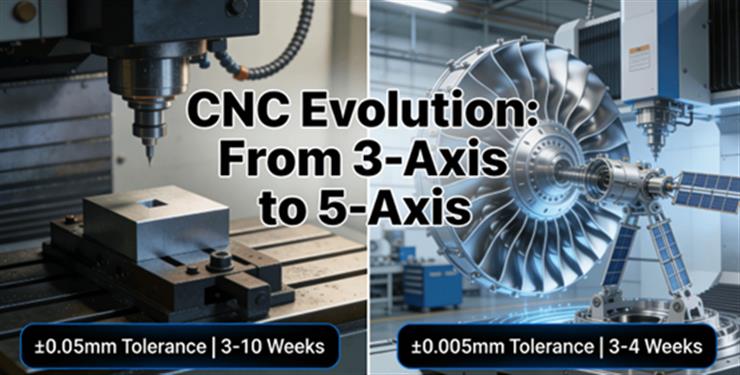
:Infographic comparing traditional 3-axis machining with modern 5-axis CNC milling, highlighting improvements in tolerance and lead time.
However, the appropriate strategy in the selection of the right CNC turning and milling services depends on the volume of production, the specification of the material used in the process, as well as the precision needed in the process. A systematic approach is essential in the equipment selection process as well as the certification process.
H3: Selection Matrix: Industrial-Grade vs. Desktop-Level Equipment
For the mass production of critical components, industrial-grade 5-axis centers offer the required rigidity and tolerance accuracy of ±0.005mm. Desktop machines, though cost-effective, are usually limited to prototyping of soft materials and cannot be used for mass production. For businesses with specific CNC turning services needs, a hybrid approach of using rapid prototyping for validation before scaling up using industrial machines could help achieve optimal capital investment.
Meeting Stringent Requirements of AS9100D Aerospace Certification
For industries that require high standards, such as aerospace, compliance with a standard such as AS9100D is a requirement. Machining high-temperature alloys requires specific fixture designs, such as those that include cooling channels, and tool paths that account for tool wear, in order to ensure integrity and precision.
Conclusion
Thus, in summary, precision technology in computer numerical control milling machines, which enables multiple axes of control, digital quality control, and material optimization, is a key technology for the modernization of manufacturing industries in the country. It addresses the critical needs of the country in terms of cost efficiency and precision, which are required in industries such as automobiles, aerospace, and medicine. Expert services would be required for a smooth transition of the technology.
Author Bio
The author is a technical analyst with expertise in the field of manufacturing digital transformation. He has considerable experience in consulting for automotive parts suppliers in Southeast Asia. His work has also been published in the Indian Industrial Review.
FAQs
Q1: What is the average payback period for an investment in a 5-axis CNC milling machine?
A1: The payback period typically varies between 18 and 36 months. Nevertheless, in high-volume production environments such as automotive parts production, the synergy effect of increased efficiency and decreased scrap rates may result in a payback period of as little as 12 months.
Q2: How can a customer check the accuracy claims of a CNC milling equipment supplier?
A2: It is imperative to ask for proof of an ISO 9001-based quality management system and to examine the CMM data history. The emphasis should be on the long-term stability of the tolerances, rather than a single value.