




















































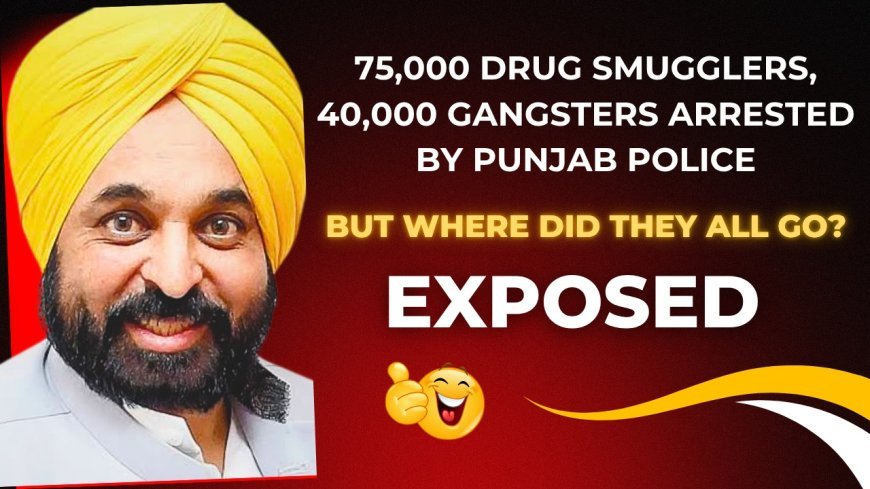
75,000 Drug Smugglers, 40,000 Gangsters Arrested by Punjab Police — But Where Did They All Go?

AAP government's claims and overcrowded jails raise uncomfortable questions
By Satinder Bains
CHANDIGARH: The Punjab Government's relentless publicity blitz on its anti-drug campaign, "Yudh Nashian Virudh," and anti-gangster drive, "Gangsteran Te Vaar," has projected an image of unprecedented success in the fight against crime. The real picture however raise many uncomfortable questions on the claims made by AAP government in Punjab.
Official press releases repeatedly claim that more than 75,000 alleged drug smugglers have been arrested in the last 17 months, while nearly 40,000 gangsters and their associates have been rounded up during the anti-gangster campaign. Together, the two drives account for nearly 1.15 lakh arrests.
The figures make impressive headlines. But they also expose a glaring contradiction that the Bhagwant Mann government has so far failed to explain.
If over one lakh accused have been arrested, where are they?
Punjab's prison system simply does not have the capacity to house such staggering numbers. The state has 26 prisons—including central jails, district jails, sub-jails, women's jails, a borstal institution and an open jail—with a sanctioned capacity of about 26,500 inmates. Even after overcrowding became routine, the prison population has reportedly hovered around 38,000, pushing many jails far beyond their limits.
The overcrowding is most visible in Punjab's largest prisons.
Amritsar Central Jail, built for around 2,200 inmates, has reportedly housed nearly 4,700 prisoners, more than double its sanctioned strength. Ludhiana Central Jail, designed for about 3,200 inmates, has accommodated well over 4,500 prisoners. Several other prisons are also bursting at the seams, forcing jail authorities to manage inmates far beyond the facilities' designed capacity.
Against this backdrop, the government's arrest statistics raise more questions than they answer. Even if every prison in Punjab were filled to capacity, they could not possibly accommodate the numbers reflected in the government's own press releases. Yet the government has not disclosed what became of the tens of thousands of people it says were arrested.
Were they all sent to judicial custody?
How many secured bail from courts?
How many were released after police investigation?
How many were found innocent during verification?
How many arrests involve the same individual in multiple FIRs?
How many have actually been convicted?
How many are still behind bars today?
The government has offered no comprehensive answers.
This lack of transparency has made it impossible to independently assess whether the campaigns have resulted in lasting action against organised crime or whether the arrest figures represent cumulative police action in which thousands of accused have subsequently been released.
The contradiction becomes even sharper when viewed against the ground reality.
Despite the government's claim of arresting more than 75,000 alleged drug smugglers, narcotics continue to be readily available across many parts of Punjab. Police continue to register fresh NDPS cases almost every day. Drug overdose deaths continue to be reported from villages and towns across the state.
Similarly, despite the claimed crackdown on gangsters, incidents of extortion, targeted killings, shootings and violent gang rivalries continue unabated. Businessmen continue to receive extortion calls. Gangsters operating from prisons and from abroad continue to surface in criminal investigations.
If thousands of major drug traffickers and gangsters have already been taken off the streets, the public naturally asks why the drug trade and organised crime continue to flourish.
The issue is not whether Punjab Police has made arrests. It undoubtedly has. The real issue is whether the government's publicity reflects the complete picture.
For a campaign of this magnitude, the public deserves more than cumulative arrest figures. It deserves detailed disclosure of how many accused remain in jail, how many have obtained bail, how many have been acquitted, how many have been convicted and how many cases are still pending before courts.
Until those figures are made public, the government's headline numbers will continue to invite scrutiny rather than unquestioning acceptance.
For a state battling one of India's most serious drug crises, credibility is as important as enforcement. Statistics may win headlines, but only transparency can win public trust.
What's Your Reaction?
 Like
1
Like
1
 Dislike
0
Dislike
0
 Love
0
Love
0
 Funny
0
Funny
0
 Angry
0
Angry
0
 Sad
0
Sad
0
 Wow
0
Wow
0